Showing posts with label Book reviews. Show all posts

Monday, September 7, 2009

Book Review: Under the Banner of Heaven - A Story of Violent Faith by Jon Krakauer

Under the Banner of Heaven - A Story of Violent Faith
by Jon Krakauer
4/5 stars

Lights and Reflections of the Temple Square
(Temple Square in Salt Lake City)

What a book. Krakauer presents the Mormon church through the broad lens of their history, beginning with Joseph Smith and working through to today. He also focuses in on the modern-day story of Dan and Ron Lafferty, two members of a fundamentalist Mormon splinter group who murdered their sister-in-law and niece in cold blood because they believed God told them to.

Although the book is about the Mormon church and the Fundamentalist Mormon church, the underlying theme is Krakauer wrestling with faith. How and why do people believe, and what defines the difference between those who lead peacefully pious lives and those who follow their faith into extreme and sometimes violent acts. Those questions are really what made the book powerful on top of the very interesting history.

Reading about the history of Mormonism is always fascinating - it seems so utterly ridiculous that I just find it stunning that so many people follow it. In any case, most of the history section was well-written and interesting. The description of the splinter groups off of Mormonism was also fascinating. A couple of years back when Warren Jeffs was arrested I was treated to some public display of the Fundamentalist Mormon church, but Krakauer explains their history and WHY they believe what they believe. For the most part they practice polygamy and spurn both the modern-day Mormon church and the US Government. It was shocking to see how these splinter groups are simultaneously twisted together as well as scattered and divided.

Warren Jeffs with a 14 year old bride:
Warren Jeffs

One fascinating section described the trial of Ron Lafferty, one of the murderers described above. Though Ron didn't claim to be crazy, at one point in his trials there was a lot of debate about whether or not his fanatical beliefs and actions made him crazy. There was a huge reaction to this charge because while Ron was certainly eccentric, he wasn't a loner, he wasn't withdrawn or humorless. He was social, a big thiner, loved to laugh and in general couldn't be defined as crazy, only zealous. If the court found him insane, it would be purely for his religious beliefs. While his beliefs were unconventional, believing that God spoke directly to Him, that demons were around, and that he was in a battle for God's purpose in a world controlled by evil is actually the prevailing belief of many, many people in the US and the world.

Interesting, eh? I plan to write a little more about my thoughts on this on my theology blog, but I'll close with Krakauer's own closing words, which explain his own perspective on faith that informed the search and writing of this book.

"I don't know what God is, or what God had in mind when the universe was set in motion. In fact, I don't even know if God even exists, although I confess that I sometimes find myself praying in times of great fear, or despair, or astonishment at a display of unexpected beauty.... And if I remain in the dark about our purpose here, and the meaning of eternity, I have nevertheless arrived at an understanding of a few more modest truths: Most of us fear death. Most of us yearn to comprehend how we got here, and why - which is to say, most of us feel the ache to know the love of our creator. And we will no doubt feel that ache, most of us, for as long as we happen to be alive."

Friday, September 4, 2009

Book Reviews: Secret Life of Bees and The Opposite of Love

The Secret Life of Bees

The Secret Life of Bees
by Sue Monk Kidd
3/5 stars

The Secret Life is a super popular book and movie, but this was my first exposure. I've been reading some pretty long books recently, so this was a refreshing, quick read. It was heart-warming and dealt a lot with loss and trauma in childhood. It was really beautiful to a child find a place that she is truly at home, and of course that is seen as pretty unusual since she's a little white girl and is staying with a rather eccentric group of black women. So yes, it's beautiful. The depiction of a syncretistic faith drawn from Marian exhaltation in Catholicism and some flat out animistic practicies is probably realistic, but I sure hope readers aren't being influenced by it!

The Opposite of Love
by Julie Buxbaum
3/5 stars

Total chick book. :) Buxbaum's work received RAVE reviews from several bloggers I follow, so I ordered it to see what everyone was so excited about. It IS a good book, and I think it would be a really good book if I had grown up in America. The main character reminded me of the girls I worked with in Chicago - good but somewhat broken family, driven professionally but feeling empty inside, searching for romance, alternately hitting up parties with friends and hibernating in her apartment. The novel totally dug into the heart of a young professional - the longing for love, for family, for meaning.... so I see why everyone raved about it. For me, though, it made me feel like I'm from an alternate universe. Even though I have worked in that world, my heart is in the jungle and the mountains, in third-world countries, or working with my refugees. I struggle to relate to the world of young professionals in America, so even though the book was GOOD, it was a little hard for me to relate to.

Friday, May 22, 2009

Book Review: Death Comes for the Archbishop by Willa Cather

Death Comes for the Archbishop by Willa Cather really took me off guard. I, like many people, read My Antonia in school. I knew from that experience that Cather is a master word-smith, and truly paints a picture better than any other author I've ever read. She makes landscape come alive in a way that words aren't supposed to be able to do.

My Antonia fits Cather's life. Cather grew up in a small town in Nebraska, and My Antonia reflected that experience and was a melancholy, emotional coming of age story rooted in the world of immigrants in the Nebraskan prairie. The story flowed naturally out of her own past.

Because of that, Death Comes for the Archbishop really took me off guard. It's a story based on the life of the first Archbishop in New Mexico. It is a deeply Catholic novel, it is steeped in the world of the desert, Indian myth, and the history of the the southwest. It felt like a biography in story form - there is very little dressing up of the story, it is very matter-of-fact. I had to do some research on Cather's life to understand how a girl from the prairie could write about a world that was so far from her own experience. France, Catholicism, the southwest? How could she know enough to write a full novel about these things? It seems as though she was actually quite a researcher and a masterful journalist, and she really painted a great picture of the southwest through the eyes of a true historical character, a French Catholic Archbishop.

I was fascinated because I love historical fiction and this is from a period that I know very little about. The story starts just as New Mexico is made U.S. territory, and this French BishopLatour is assigned to the territory from his previous post in Mexico. He and his dearest friend, Father Vaillant , trek across the Gulf of Mexico and the desert to get to Santa Fe, and are there as their territory expands into Arizona and then up into Colorado when the gold rush hits. Cather gives you a peek into the world of the Hopi and Navajo Indians that the Bishop learns to respect despite their deeply ingrained animist beliefs. Kit Carson is a major character, and the desert is itself is very nearly a character as well.

Santa Fe, New Mexico

It was really a fascinating book, but as I said, it almost felt more like a historical biography than a work of fiction. It isn't plot intensive, though it is beautiful. For me personally it wasfascinating to see how Cather portrayed the life of a missionary. My life as the child of missionaries was of course very different than these turn of the century Catholic priests, but there are still some shared experiences. I loved this passage, where the aged Bishop is contemplating returning home to France to die or staying in Santa Fe.

[Returning to France] seemed the natural thing to do, and he had given it grave consideration... But in the Old World he found himself homesick for the New. I twas a feeling he could not explain; a feeling that old age did not weigh so heavily on a man in New Mexico as in thePuy-de -Dome. He loved the towering peaks of his native mountains, the comeliness of the villages, the cleanness of the country-side, the beautiful lines and cloisters of his own college.Clermont was beautiful, - but he found himself sad there; his heart lay like a stone in his breast. There was too much past perhaps...


Just a few pages later the aged Bishop recognizes that his memory is changing.

He observed also that there was no longer any perspective in his memories. He remembered his winters with his cousins on the Mediterranean when he was a little boy, his student days in the Holy city, as clearly as he remembered the arrival of M.Molny and the building of his Cathedral. He was soon to have done with calendared time, and it had already ceased to count for him. He sat in the middle of his own consciousness; none of his former states of mind were lost or outgrown. They were all within reach of his hand, and all comprehensible


Twisted Tree in the Badlands

All in all, I'm quite impressed with Cather's range of writing ability. I really enjoyed Death Comes for the Archbishop, mostly because it was about a time and place I knew nothing about.

4/5 stars.

Saturday, April 18, 2009

Book Review: A Day in the life of Ivan Denisovich

I finished "A Day in the Life of Ivan Denisovich" by Solzhenitsyn. It's a very short book but this is the third time I've tried to read it. Every time it has been captivating, but the first time I lost the book and the second time I left the city whose library I was borrowing the book from.

Russian writing is interesting. I wonder if American writing has such a unique overall tone to it? Tolstoy, Dostoevsky, Solzhenitsyn.... to me they all have a similar way of writing that is much darker than American writings. The other day Amy mentioned that in general she doesn't like Brit Lit because of how stiff it is. For a minute I disagreed... mostly because I love British literature, but after thinking about it I had to agree (not with her dislike but with their stiffness). Stiff isn't necessarily bad, it just reflects a culture. British literature tends to be very structured and have a bit of an impersonal tone to it. Some prefer it, some don't. I wonder if Russian literature reflects the Russian personality and culture as well. To me, Russian writing is amazingly deep but also incredibly pessimistic. They are philosophical to a fault, taken up with monotony, sort of spontaneously passionate, and very rarely joyful. They understand the complexity of emotions and relationships but their writing is rarely FUN.... it's heavy.

A Day In the Life is amazing because it is a day in the life of a prisoner in a work camp in Siberia (I think). It is unique because Solzhenitsyn himself spent years in a prison camp FOR his writing, so he is writing with a personal perspective of what it is like to live a day amidst years of painful monotony and little hope of justice. Of course, that day is incredibly monotonous and yet the author manages to plumb the depths of the mind and emotions of the prisoner throughout the day. At the end of the book I put it down and decided it was a book about life, and life to the fullest. Even amidst the camp this man is industrious, ambitious, filled with longing and joys and satisfactions and pains. It's... actually quite inspiring.

I think part of the point of the book is to celebrate the indomitable spirit of humanity. Despite oppression, poverty, sickness, and persecution, we can choose to live.

Solzhenitsyn

Solzhenitsyn fascinates me, particularly in comparison with another brilliant writer, Ayn Rand. Both left Communist Russia and condemned Communism, but with absolutely opposite premises. Their books both celebrate the human spirit, but they disagree completely about what that spirit actually is. Solzhenitsyn's exiled life in the US after his imprisonment and in the USSR is so interesting as well, because he kept himself surrounded by Russia even in the US. He never wanted to integrate and considered our society to be very corrupt, though in a different way than Russia. They were corrupt in the government, we were/are corrupt morally. When Solzhenitsyn could finally go back to Russia after Communism collapsed, still he struggled. He was certainly an idealist, but also a brilliant man, and a hero.

Friday, April 10, 2009

Book Review - The Last Sin Eater by Francine Rivers

My bookish blogging friends challenged my disdain for Francine Rivers (which I picked up from my fav. college lit professor, who called Rivers Christian crap-o-rama). Maybe I was being too harsh. Maybe there was a depth to Rivers that is often missing in popular Christian fiction.

Well - if Francine Rivers has a greater depth than most, it wasn't evident in "The Last Sin Eater". I didn't like it. I mean, I actually really liked the concept, but about half-way through the novel the concept started unraveling into a simplistic evangelical salvation presentation. See my review of the movie "Fireproof" to read more of my complaints about simplistic presentations of salvation. I don't have a problem with Christian art and literature, but I do have a problem with bad Christian art and literature.

See, the idea of a "sin-eater" is I guess from old Scotland and Whales, where communities would a assign one member the duty of "eating" the sin of community members that passed away. This insured that only one member of the community had to carry the guilt of sin and everyone else would be purified at their death.

Obviously, that is a very, very cool metaphor that parallels with the gospel very clearly. Thing is, while it started as a metaphor set in a superstitious mountain community was turned into a modern gospel pitch, and it just didn't fit culturally so it wasn't believable. It might have worked as a kids story... but I kept thinking, "You can't make the jump from not knowing anything about Christianity to suddenly talking like a 70-year-old pastor! That's cultural lingo - it's not imparted by 'praying the prayer'!".

Anyways - I didn't like The Last Sin Eater.
Rating - 2 out of 5

Monday, April 6, 2009

Dagny Galt and rational self-interest

Book Review: Atlas Shrugged by Ayn Rand
reposted from my old blog

Atlas Shrugged was a fantastic book, one of those books that is not only well-written but is also a page turner (except the 100 pages towards the end of the book that is a SINGLE monologue).

One of the interesting things was that the main character, Dagny, reminded me of my old boss (I won't say which one!). It was uncanny. I started reading it at the same time that I was watching a crazy situation go down at work, and it was like reading a biography of my boss in some ways. You know that kind of person that is a self-motivated and a driven perfectionist, so they go go go all the time. They get everything done and when they get a vision of something, they will do anything and everything to make it happen. They can turn around companies, change countries, make their mark in history. They are also incredibly demanding of everyone else around them.

That kind of person is the only person of value in Atlas Shrugged. In most perspectives that character would be a "bad guy." In Atlas Shrugged they are the heroes, the only ones that keep the world running. By the end of the book, I saw her point. It was actually very convicting, all the talk about hard work, drive and dedication, and business and industry. I feel as though I have honestly walked away from this book changed, the way one might speak about a religious book. I don't buy into her worldview, but it certainly influences mine. This is strange because Rand is a hard-core capitalist with no room for charity or religion or anything that she views as "weak".

One thing that really struck me was the central theme of rational self-interest. As I started seeing that thread wind its way into the book I thought of how opposed it is to everything you hear in Sunday school. Rand sees no reason to give to the poor, no reason to help your brother, and no reason to be selfless. Actually the point of the book is selfishness. The further I got into the book I began to question my automatic push back against that theme, partly because of a few comments from a philosophy guy at church. Why do we come to God? Why should someone "become a Christian?" I always felt like it was ... selfish... of me to have come to God, since in the end my best reason was that I did it for myself. Aren't I supposed to do things for God? And yet God doesn't need me... I'm not doing it for Him, I do it for me. Rational self-interest. Isn't God the only truly rational self-interested choice for humans? Sure, a life following Christ doesn't feel as though it is for ourselves, it can actually be quite painful. In Atlas, though, the main characters go through a great amount of pain to achieve an ultimately better life for themselves.

Interesting. It seems to me that applied without God being true, Rand's philosophy is brutal, cold, and perhaps even devastating. Applied assuming that God is true, it is transformational, because all of that energy and determination is given to the pursuit of God.

Then there is the character of John Galt... He is the first to truly turn to rational self-interest. The more I thought about the character, the more I came to the conclusion that it's an interesting picture of God. I think of self-interest as a bad thing... but for God? Isn't it not only rational but good and right and ... the only possible way of things... that God be fully self-interested? That gives a different twist on how I look at salvation-history and why it is the way it is.

Oh, and her ideas about sex and love and women are way before their time, if you ask me. Interesting. The other thing that struck me was that Rand's extreme views of capitalism came out of her life in Communist Russia before coming to the US. Comparing her experiences and conclusions to Solzynitzyn's is really striking- they went opposite directions, really. Rand emphasizes capitalism and the importance of self-interest, while Solz. emphasized moral religion and scorned self-interest.

Fascinating

public 7:30 PM 8 views 4 eprops 2 comments edit

Saturday, March 21, 2009

Book Review: Song of Saigon: One Woman's Journey to Freedom

Reposted book review from my former blog
Song of Saigon: One Woman's Journey to Freedom
By Anh Vu Sawyer, Pam Proctor

So I just finished this book - flew through it. I keep reading books that unexpectedly intersect with my life. This woman's story is incredible. She begins with the somewhat miraculous tale of pushing through crowds and somehow ending up with her ENTIRE family on one of the last helicopters out of Saigon when the US pulled out of Vietnam.

Then she goes back and begins with the story of her grandfather, an angry opium addict who goes through detox under a missionary and becomes a committed Christian, builds a big happy family, and becomes head over all of Vietnam's railroads.

Then the story of her mother, a spunky woman who falls in love and then loses that life when the battle between the French and the communists breaks out. She ends up marrying a communist leader who had once been imprisoned by the Japanese in the same "Hanoi Hilton" prison in which John McCain was later held. He defects to the French in the end, and that story leads into the moment when he, his wife, and their children get out of the country on the helicopter.

In the journey out of refugee camps, they are adopted by a church in west Chicago. She has an offer to be cared for on her own by a guy who wants to pay her way to medical school. In the end the family turns down that offer for keeping the family together, and he ends up stalking her - and is later arrested for being part of a prostitution ring that preyed on the Vietnamese refugee girls. Yuck. In any case, one of the church women who helps her with the stalker thing is "Mrs. Ritchie", which I realized is the SAME as the wife of the guy who wrote "God in the Pits" that I read a few months back. Wow - that guy was an mk from Afghanistan, and his passion for refugees led him to lead his church into adopting Vietnamese refugees and helping them integrate into society. The rest of the book I knew I was looking at a life that was totally transformed by the passion of Mr. Ritchie, who is awfully like me in his cynicism about the church but love for people overseas. Cool.

In any case, the main character goes to Wheaton for a year, where she gets to know EVERYONE (I can just picture it, we had a few international students like that at my Bible college) and is entirely clothed by the missionary barrel (yep, me too). She falls in love with the most unconventional boy on campus - who is unconventional enough to be labeled by the student body as a "homosexual", a word that she doesn't understand for 10 more years. In any case, he is not, and after several years of long distance dating, they marry and move to inner city NY, where she works for a travel company and becomes a total fashionista (crazy life!). She said she would use her weekends to fly to Boston and shop all Saturday at Filene's basement for shoes, which just cracks me up.

The story goes on, but what a life she led! The ins and outs of what she goes through in light of her family history is really amazing. I love autobiographies.

Friday, March 20, 2009

Book Reviews: Lipstick Jihad, Wild Swans, Churched, Spirit of the Rainforest

Reposted from my old blog - Christmas break reading reviews

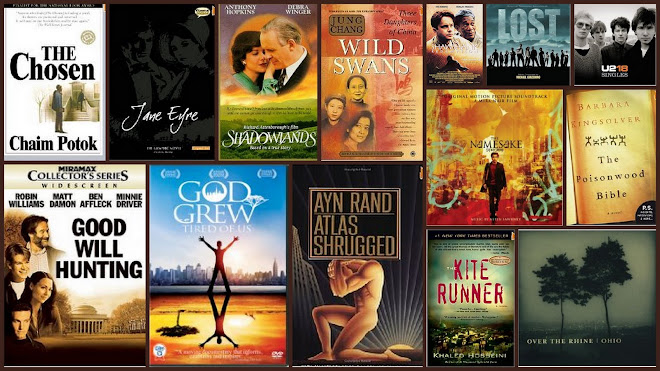
Wild Swans - by June Chang
This book was excellent. June has written about her family history in China, focusing on the women. It's just stunning - her grandmother was the concubine with bound feet for a warlord. Her mother was a passionate underground worker for the Communist revolution. She married another passionate revolutionary and together they rose into leadership in the communist party and wow... reading their story is really fascinating. Such people of great principle and self-sacrifice! June's story begins as a child in Communist China, and the family story quickly sours as Mao's rule turns its back on its own heroes in the Cultural Revolution. It was really enlightening to see how she viewed Mao and Communism and the West, and how her perspective slowly changed. I LOVE history and life stories, and this was a perfect combination of both, and was really educational in the process.

Lipstick Jihad - Azadeh Moaveni
Eh. This is the autobiography of an Iranian American who goes back to Iran to be a reporter. That story in and of itself has so much potential, but to me it just seemed like an overly narcissistic rambling memoir without much depth to it. It tries, but it falls short.
lipstick Jihad

Churched: One Kid's Journey Towards God Despite A Holy Mess - Matthew Paul Turner
I gotta tell you, this was hard for me to read. I think the title is misleading. Matthew Turner is actually telling the story of his childhood in a very conservative fundamentalist atmosphere. Although the stories are actually very funny and entertaining (mostly because of how ludicrous many of these well-meaning fundamentalists were) they make me feel sick. The atmosphere I grew up in is not this conservative, but I am still very aware of fundamentalism and its flaws. The way God was represented to a generation of fundamentalist kids just... makes me feel sick. There is hope in the last chapter, and the author says that he is now very wary of much of church, but has been pursued by loving, authentic people that have really brought about redemption. That's great, but .... there is enough truth in the book that hits close enough to home for it to be a difficult read for me.

Spirit of the Rainforest: A Yanomamo Shaman's Story - Mark Richie
This book was a really good book. At first I thought it was going to be a missionary story, but it is not. Mark Richie (who I actually met last year before I even knew this book existed) is retelling the story of the life of a Yanomamo shaman, and it is autobiographical based on hours and hours of recorded interviews. In the process the shaman tells the story of his people as missionaries, priests, and anthropologists arrive in their remote jungle villages and begin to influence the Yanomamo with their various perspectives.

The book is fascinating for several reasons. First of all, it is a middle ground between two competing sides. We hear missionary stories all the time, and we hear anthropological perspectives about tribal life. In fact, one of the main characters in the story is the anthropologist Napoleon Chagnon who wrote the most well-read anthropology book of all time about the Yanomamo. This book shows you what the Yanomamo think about all sides - it identifies the hypocrisy of some missionaries, the cultural bias of the anthropologists, and the caught-between cultures Yanomamo, who neither want to give up their identity or be forced to remain in what they consider to be lives filled with suffering.

It IS the perspective of a shaman turned Christian. He only joins the followers of "Yai Pada" in his old age, and hearing about his spiritual perspective as a shaman is shocking for me - it is unbelievable to my naturalist mind. At the same time, hearing how he perceives the message of Christianity from a spirit-filled perspective is really really interesting.

It was a good book. It made me mad and it made me think and it made me pray.

Saturday, March 14, 2009

Book Review - Sons and Lovers by D.H. Lawrence

- reposted from my old blog -

sons and lovers

I loved this book. It reminded me again of my love for classic English literature. I love the realism in it.
Warning: the book deals with sex. I talk about it. If you're sensitive to that sort of stuff, don't read it.

"Sons and Lovers" is essentially about relationships. I thought it was going to focus on the relationships of the mother in the book, because the first part deals with her marriage and the stages it goes through - the disintegration of love, essentially, and what it's like to be a woman and have to rely on a man. Then it focuses on her relationship with her sons, and how she transfers that longing for love and hope for the future to her sons, to whom she is an amazing mother. In fact, TOO good of a mother, because the second half of the book is about one of the sons. Lawrence wrote the book to reflect his own relationships with his mother and then lovers, and you can see him trying to process that question we all ask, "Why do I do what I do?"

He was affected by Freud, who he knew through his lover (in real life), and he recognizes that his mother loved him too much, and the co-dependant relationship is like that of lovers without ever being sexual. He recognizes that this leaves him quite dysfunctional in the two relationships that Lawrence has, which are reflected by the two relationships that the son, Paul, goes through in the book.

My predominant reaction going through the book was frustration the character's actions even when I loved them, which is a good thing, it's a sign of being sucked in to the story. The mother is held up as a bit of a long-suffering heroine matched to a loser drunk, but I was even frustrated with her. She's married to a simple man, but a man of joy and loyalty and fun... he's quite quaint. She scorns his simpleness, and I kept thinking... gosh, if she would love him for who he is instead of scorn him because of what he's not, perhaps he'd stay at home instead of heading to the pub for drinks. I think that she ruins him. If she had chosen to love and invest in him even after realizing his flaws, he probably would have blossomed under that love.

And then it was frustrating to feel how trapped the mother is in her life as a woman in that time. She is an incredibly strong woman, and independent. She runs her home and raises her children and holds them together when the father is virtually MIA and totally useless, and begins beating her at times. What option does she have, though? She CAN'T leave, because she can't work. As a woman, she has no place to go where she could actually support a family if she left her husband, even in the worst of the abuse and neglect. I'm certainly glad to live in this day and age as a woman.

Paul, the son, is an incredibly introspective man who longs for beauty and love and connection, but struggles to love while he is so loyal to his mother, and she jealously holds him to her even as he's tentatively looking for a wife. It's so annoying, because you know the mother has placed so much hope in her son and therefore wants to hold him above a woman who might ruin him. In doing so, though, she IS ruining him, because he longs for a woman and yet can't give himself fully while his mother holds him back. Then, when he turns to a woman who will love him physically, the mother accepts this because it doesn't involve his soul, only his body. This also is devastating, though, because the body only satisfies for so long and the soul cries out for a deeper connection, a deeper love.

Reading of Paul's relationships made me SO thankful for Isaac and the way he loves me. Paul's first girl is a childhood friend who is also incredibly introspective, and they connect in a really REALLY deep way. They understand each other, seem to peer into each other's souls. They do this for years, all the time seeming to prepare for a life together, they seem made for it. One reason it doesn't work is Paul's loyalty to his mother, who hates the girl for her hold on Paul. The other reason, though, is the way the girl has idealized this spiritual connection that she and Paul have, and yet divorced it from sexuality. They are both raised in a puritanical religious environment, and the girl absorbs that puritanical revulsion towards sex. It is demeaned as an uncontrollable bodily urge that is essentially dirty. She realizes, though, that if she wants to keep Paul, after 7 years he as a man loves her and wants her. She has to give herself to keep him, so she does, but she does it as if she were a martyr going through a willing sacrifice for her lover.

Lawrence's description of this is amazing. He describes how Paul feels like he is dying as he realizes that when they should be fulfilling the height of love, connecting soul, spirit, and body..... she has essentially removed her self in horror. She is there in body but it was like her soul was just standing by and waiting until his physical lust was gone. Paul's grief here is so intense, because he DOES love the girl and does long to have her, all of her, and realizes that though she loves him intensely she won't love him physically, but only submit to him. SAD. I grieved for him. I worry often about the women I knew at Moody and at what they might do to their man if they go into marriage with that attitude.

Paul reacts by following his lover's example - he also begins to satisfy himself but remove his soul during the act of sex. Lawrence says at one point that the woman realizes that he isn't seeing her, Miriam, as a person, he has divorced her from the picture and is making love only to a woman. Again, sad. I have never had that experience and the description was striking to me.

This split between body and soul is too much for Paul, in the end, and he runs quickly to the opposite extreme. He meets a divorced woman who is beautiful and withdrawn because of how society has judged her. They fall madly "in love" (read: infatuated) and she is a willing and passionate lover in a way that seems to satisfy his very soul after the wrenching experiences of loving and feeling shame with the last woman. This physical love is powerful stuff, healing wounds in him but also in her from her divorce. I think Lawrence is right - most men long for a baptism in a fire of passion - they imagine loving so much and connecting equally powerfully sexually.

It's interesting reading Lawrence's description here, because he doesn't seem to be able to piece together why in his own life this deep, intense, and satisfying physical love is not enough, in the end. He seems to think that it should have been. In the end, though, it falls apart because they have no claim on each other. She won't remarry because of a lingering tie to her ex, even though she clearly loves Paul. He can never claim her and have her has his own. She realizes that while she has all of him when they are lovemaking, in life she can't touch his soul or understand him the way the previous girl could. They slowly feel alienated from each other, and it doesn't work.

See the power of it all? It is an intense, descriptive, and insightful work. It could be used in a counseling class about relationships. :) I loved it.